
Last updated September 20, 2026
Free on-site gate assessment - hinges, posts, and your LiftMaster or Nice gate operator checked before anything is quoted
The assessment is free and the quote is the invoice.
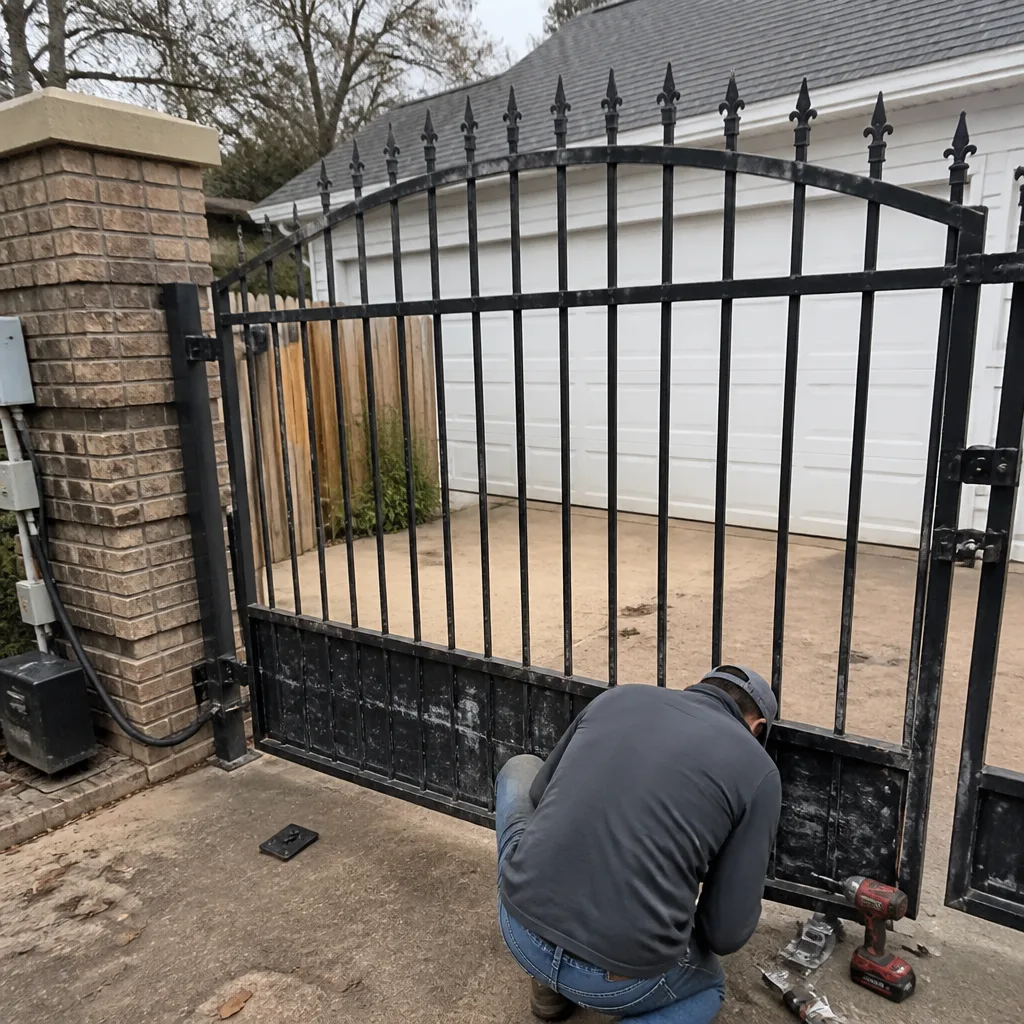 Before
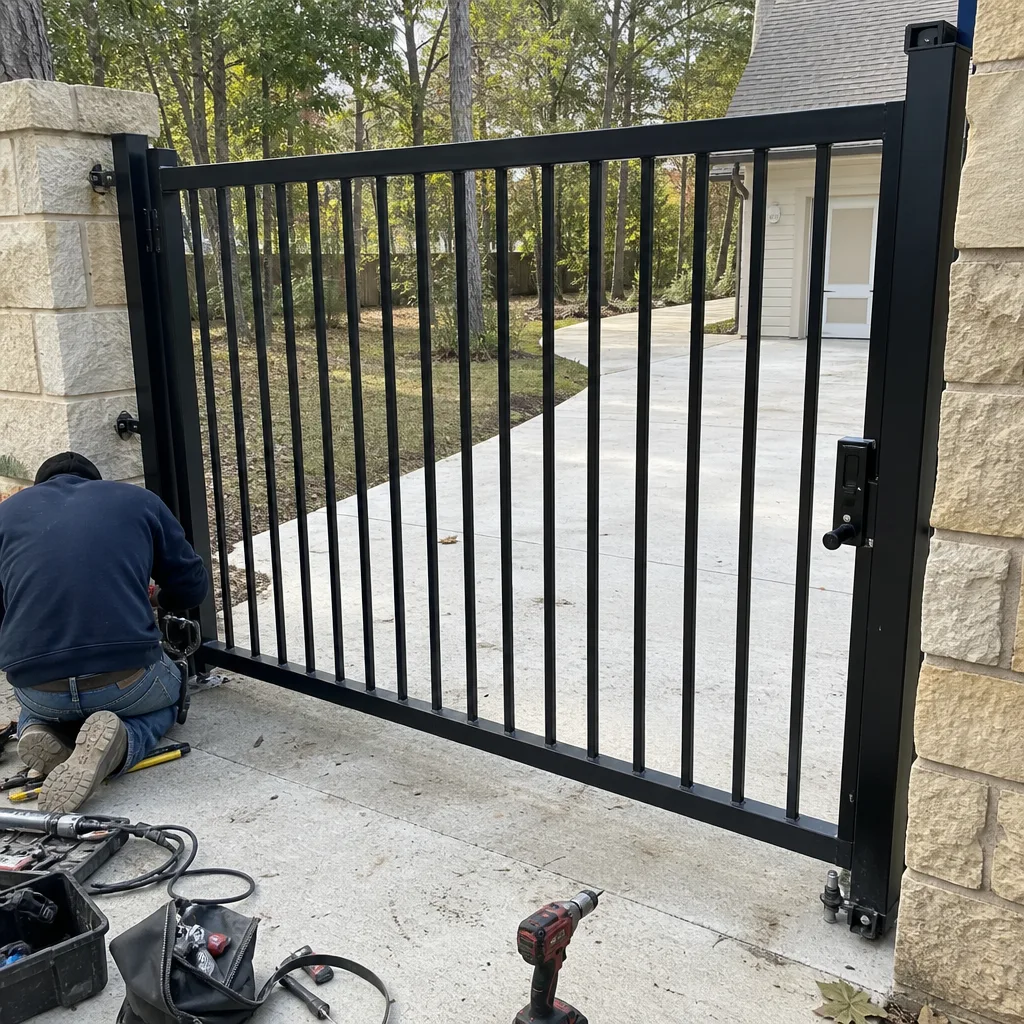 After
After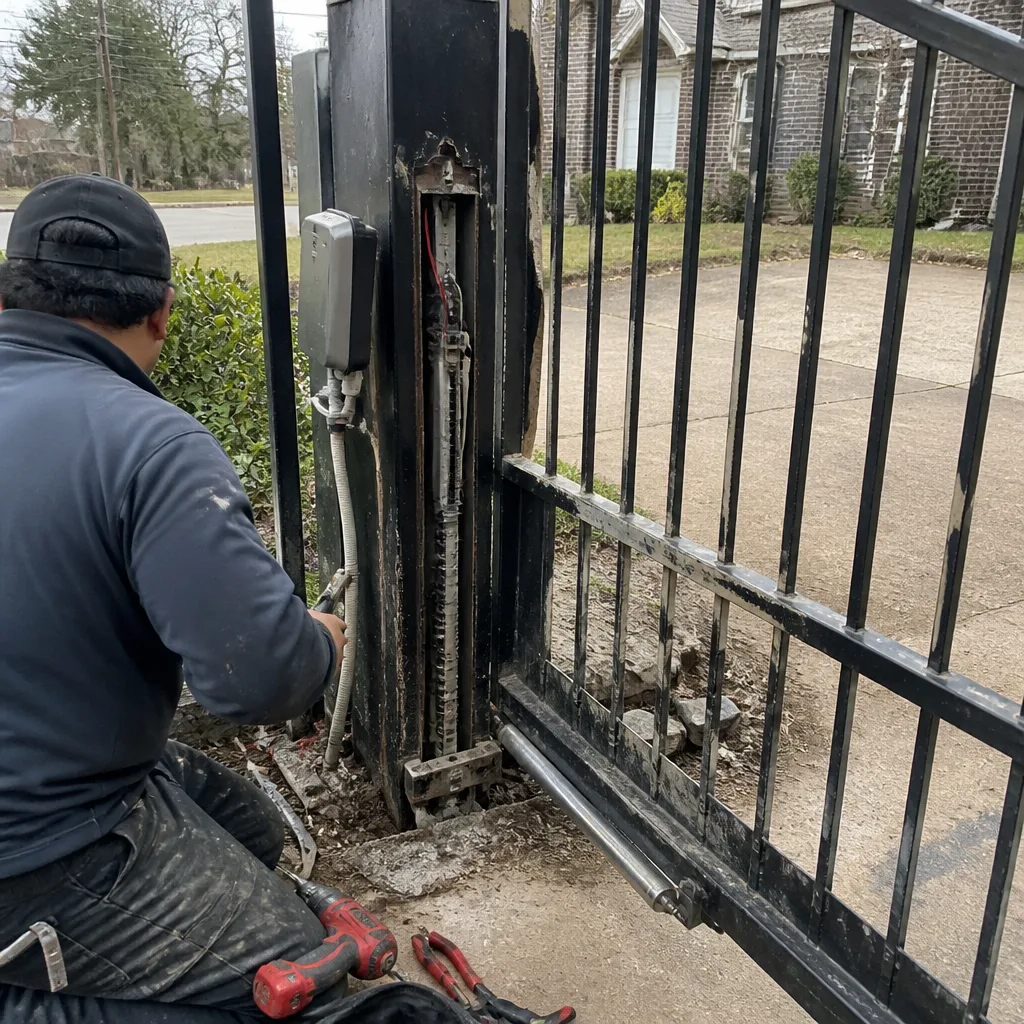 Before
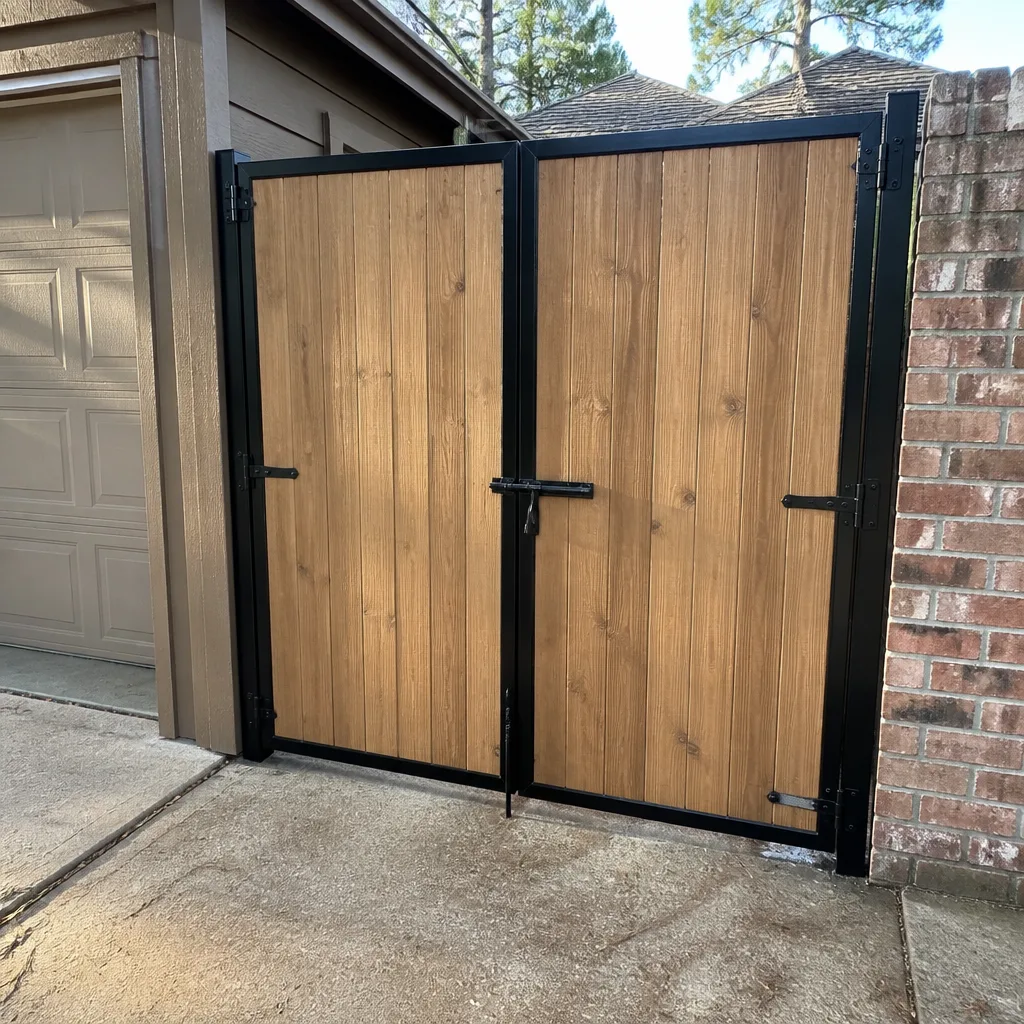 After
After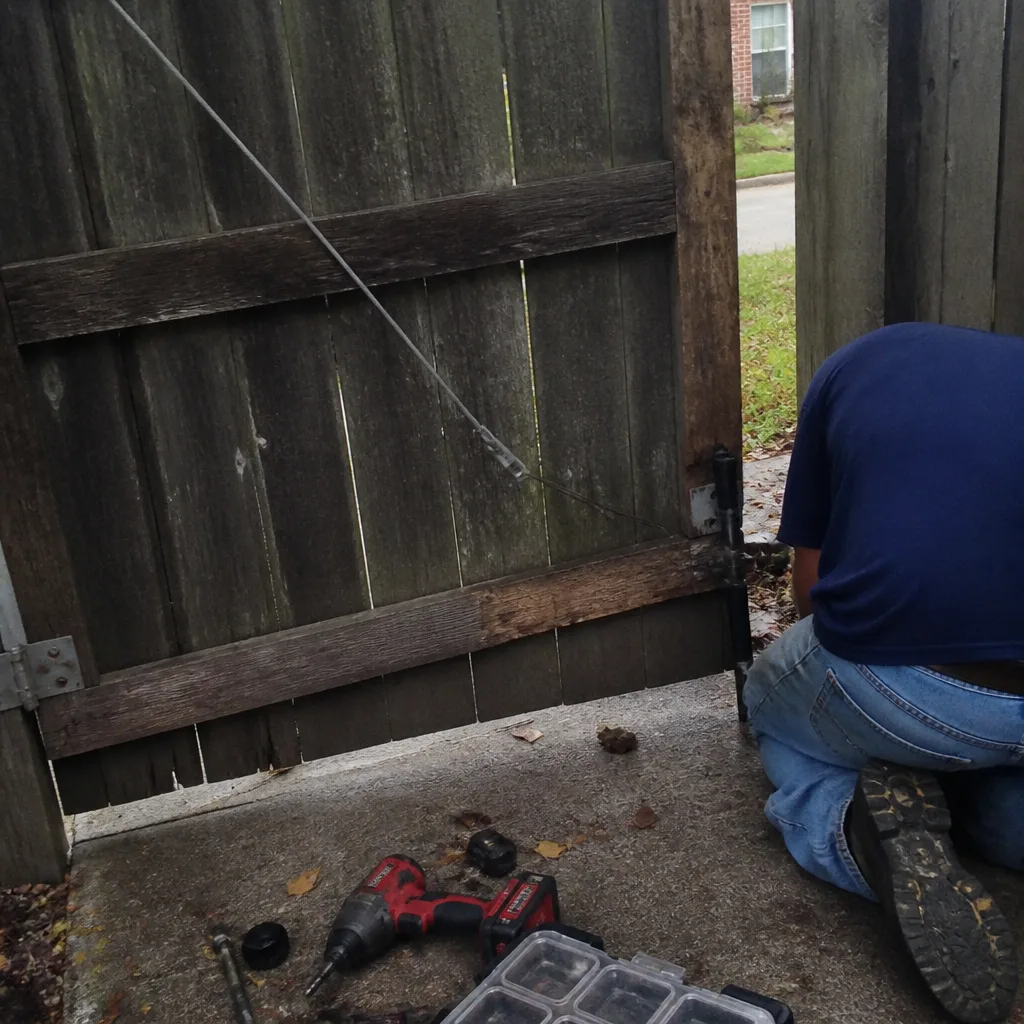 Before
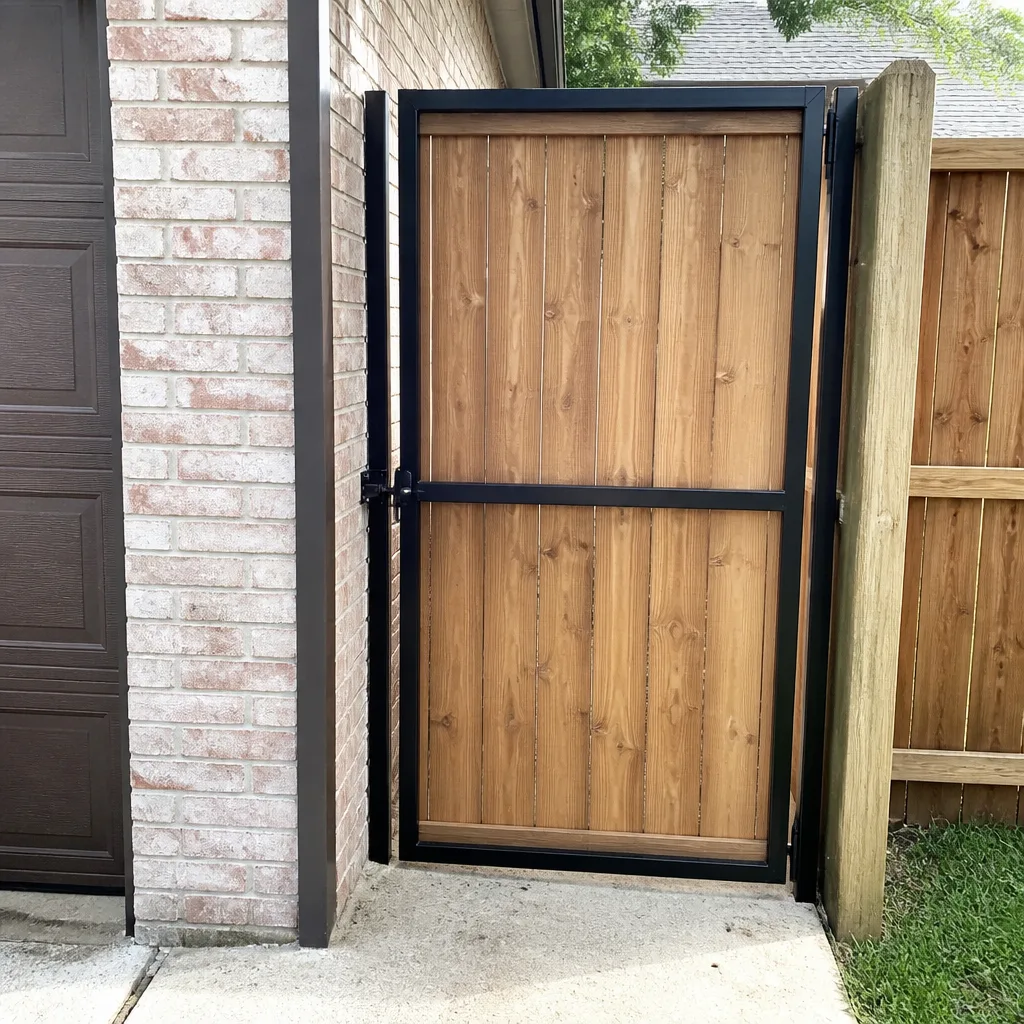 After
AfterGate Repair Warning Signs: A Humble Homeowner’s Reference Guide
A gate that still opens isn’t necessarily a gate that’s healthy. The pause you noticed last week, the click that wasn’t there last month, the remote that now needs a second press from your driveway in Humble, these aren’t quirks. They’re diagnostic data. Most gate failures don’t announce themselves with a crash. They start as a two-second hesitation, a faint grind, or a sensor that trips once and never again. By the time the gate stops moving altogether, the underlying problem has usually been developing for three to six months. This guide catalogs the specific sounds, behaviors, and visual cues that precede gate failure, so you can document what you observe and hand a technician a head start instead of a mystery. We’ll tell you what each warning sign maps to, what it costs when caught early versus late, and which signs mean the gate needs to stop running today.
Quick Answer
Gate repair warning signs fall into four categories: sound changes (grinding, clicking, humming shifts), behavior changes (hesitation, reversal, slowing), remote range drop-off, and visible wear (sagging hinge gaps, leaning posts, worn wheels). A gate that hesitates before moving is likely burning out its motor start-winding; a gate that reverses without contact is usually a misaligned photo-eye or a failing limit switch. Document what you see with photos and precise descriptions, call a professional for anything involving springs, cables, or high-current wiring, and Gate Repair services will cost a fraction of what they do after total failure.
Table of Contents
- Sound-Based Warnings: The Gate Tells You Before It Stops
- Behavior-Based Warnings: Hesitation, Reversal, and Range Loss
- Visual Checks You Can Do Without Tools
- How to Document a Warning Sign So a Technician Can Pre-Diagnose
- Immediate Stop vs. Scheduled Repair: Knowing the Difference
- Why Humble’s Climate and Soil Affect Gate Wear Differently
- What Each Warning Sign Costs to Fix, Caught Early vs. Caught Late
- Common Mistakes to Avoid
- When to Call a Professional
- Frequently Asked Questions
- The Bottom Line
BeforeAfterSound-Based Warnings: The Gate Tells You Before It Stops
Gates have a baseline sound signature. You know what yours sounds like, even if you’ve never consciously noted it. The hum of the motor, the soft thunk of the opener engaging, the rattle of wheels on track. When that signature changes, a specific component is usually degrading. The trick is mapping the sound to the part. Here’s what we listen for on service calls across Humble, and what each sound typically indicates.
The slow grind. A grinding sound during gate travel almost always points to one of three things: a wheel bearing that’s lost its lubrication, a gear inside the motor that’s wearing metal-on-metal, or a chain that’s stretched and dragging against its guide. In slide gates, the wheel bearings take the entire weight of the gate panel. When they start to fail, the gate moves slower, draws more current, and the grind gets louder with each cycle. On a BFT or Linear slide-gate motor, a grinding gearbox is a $250 to $600 repair if caught before the gear teeth shear. After shearing, you’re replacing the gearbox assembly, and the number moves to $800 to $1,400. The difference between those two numbers is often weeks of ignoring the grind.
The click-click before movement. A rapid clicking sound when the gate tries to start but doesn’t move is frequently the motor start-capacitor failing. The capacitor gives the motor its initial jolt of energy to overcome inertia. When it degrades, the motor attempts to start, can’t, and the relay clicks. This often shows up as a gate that works sometimes and refuses to start other times, worse on cold mornings. A start capacitor replacement is typically $120 to $200 including the part. If you keep pressing the remote while the capacitor is failing, each failed start attempt dumps current through the start-winding, which overheats and eventually burns out the motor entirely. That’s a $900 to $1,700 motor replacement on a swing gate. The click is the warning. The motor burning out is the tuition for not heeding it.
The hum that changed pitch. A motor that hums at a noticeably higher or lower pitch than it used to is often struggling against mechanical resistance, usually a misaligned track, a bent guide roller, or a hinge binding. The change in pitch is the motor working harder. Harder work means more current draw, more heat, and a shortened lifespan. When a Viking or Ghost Controls operator starts sounding strained on a gate it used to move effortlessly, the mechanism is asking for an adjustment, not just a louder radio.
The rattle that wasn’t there. A new rattle during travel, especially on a slide gate, frequently means the gate’s wheel trucks have worn enough that the panel is now vibrating against the track or the guide posts. It’s the gate easing itself out of alignment. Left alone, the vibration accelerates wear on every other component: the chain stretches, the motor mounts loosen, and the limit switches get jarred out of position. The rattle is the first domino in a sequence that ends with a gate off its track at 11 p.m.
Behavior-Based Warnings: Hesitation, Reversal, and Range Loss
Sound is easy. Behavior is where most homeowners talk themselves out of a problem. The gate pauses before moving, and they think, “It always did that.” It didn’t. The remote needs a second press, and they think the battery is weak. It probably isn’t. Behavior changes are the gate’s most reliable early-warning system, and they’re also the easiest to document.
The two-second pause before movement. A gate that pauses for a second or two after you press the remote, then moves normally, is displaying a textbook symptom of start-winding stress. The pause is the motor’s relay engaging while the start-winding struggles to generate torque. Sometimes the cause is the capacitor. Sometimes it’s a mechanical bind increasing the starting load. Sometimes it’s a motor nearing the end of its life. None of those causes get better on their own, and all of them get more expensive the longer the hesitation is tolerated. In our experience on gates throughout Humble, this hesitation is the single most commonly ignored warning sign. Homeowners adapt to it. The motor doesn’t.
Reversal without contact. A gate that starts opening, then reverses and closes, or starts closing then reopens with nothing in its path, is usually a limit switch that’s drifted or failed. The limit switch tells the motor where “fully open” and “fully closed” are. When it drifts, the gate thinks it’s reached its travel limit too early and reverses. This can also be a photo-eye misalignment, but photo-eye issues usually show up as a gate that refuses to close at all, not one that reverses at odd points. A limit switch adjustment on most residential operators is a straightforward service call. A limit switch that’s been ignored for months, repeatedly sending the gate into reverse at the wrong position, can chew up the gearbox and bend the gate itself. What starts as a $150 adjustment becomes a $500 to $800 repair.
Slower travel speed. A gate that opens noticeably slower than it did six months ago, whether it’s a Viking on a residential driveway or a BFT on a Humble property, is telling you about mechanical drag. The motor has a designed speed range. It slows when it’s working against resistance: failing bearings, debris-packed tracks, a sagging panel scraping concrete, or a hinge seizing. Slower speed also means the motor spends more time per cycle drawing full current, which translates directly to heat buildup in the windings. Heat is cumulative damage. Every slow cycle shortens the motor’s life.
Remote range dropping off. When your remote works from 30 feet but not from the street, the assumption is almost always a weak battery. That’s sometimes true, and a battery swap is a legitimate first step. But if a new battery doesn’t restore the range, the problem is often the receiver’s antenna connection, water intrusion in the receiver housing, or radio frequency interference from another device added to your home recently. A Ghost Controls receiver with a corroded antenna connector will show exactly this pattern: works close, drops farther out. The fix is cleaning or replacing the antenna connection, not replacing the opener. Range drop-off is almost always a communication problem, not a motor problem, and it’s cheap to fix when diagnosed properly.
Visual Checks You Can Do Without Tools
You don’t need a multimeter to spot half the problems that bring gates down. Here are five visual inspections any Humble homeowner can do in under ten minutes, and what to look for in each.
1. Hinge gap measurement
On a swing gate, stand back and sight down the line where the gate meets the post. The gap between the gate edge and the post should be roughly even from top to bottom. When the gate sags, the gap widens at the top and narrows at bottom, or the gate develops a visible downward tilt away from the hinges. A sag of more than half an inch usually means a hinge is wearing or a post is shifting. You can measure the gap with a pencil held against the post. Mark it, check again in a month. If the mark moved, the sag is progressing, and it’s a $150 to $400 hinge repair today rather than a gate dragging on the driveway and a $900 motor replacement later.
2. Post plumb test
Stand back and line up the post against a door frame, a fence line, or any known vertical reference. A post that’s leaning even a few degrees changes the entire geometry of the gate’s swing. It increases hinge load, changes the latch alignment, and forces the motor to work harder at the extremes of travel. Frost line movement in Humble’s clay-heavy soils is a real factor here. Clay expands and contracts with moisture, and a post set in poorly drained clay will move over years. If the post is visibly out of plumb, don’t wait. The post fix is manageable. The gate replacement from a failed post is not.
3. Track debris inspection on slide gates
Slide gates run on a track that collects everything: grass clippings, gravel, dirt, leaves, and the occasional child’s toy. Debris packed into the track forces the gate’s wheels to climb over it, which stresses the wheel trucks, the chain, and the motor. Run a gloved hand along the track and clear anything that doesn’t belong. Then look at the track itself. A section that’s bent, flared, or worn shiny-thin is a future derailment point. Track repair is $200 to $500 when caught early. A fully derailed slide gate, the kind that needs two people to lift back on track and usually means a bent wheel assembly, runs $600 to $1,200.
4. Wheel and roller wear
Look at the wheels that carry the gate. On a slide gate, they’re under the panel, visible from the side. On a cantilever gate, they’re inside the frame. Wheels that are visibly worn, chipped, or have accumulated a groove where they contact the track are done. They’re no longer rolling; they’re grinding. Worn wheels transfer vibration to every other component and accelerate the failure cascade. Wheel assembly replacement on most residential slide gates is $150 to $400, and it’s one of the cheapest preventive repairs you can make.
5. Weather seal condition
The rubber or brush seals along the gate edges and the operator housing do unglamorous but essential work. They keep moisture out of electronics, dust out of hinges, and debris out of the motor. In Humble’s humid summers, a failed seal means condensation inside the operator housing, which means corrosion on circuit boards, which means a $300 to $600 board replacement. Check the seals. If they’re cracked, brittle, or missing in sections, that’s a small fix and a large amount of future expense avoided.
How to Document a Warning Sign So a Technician Can Pre-Diagnose
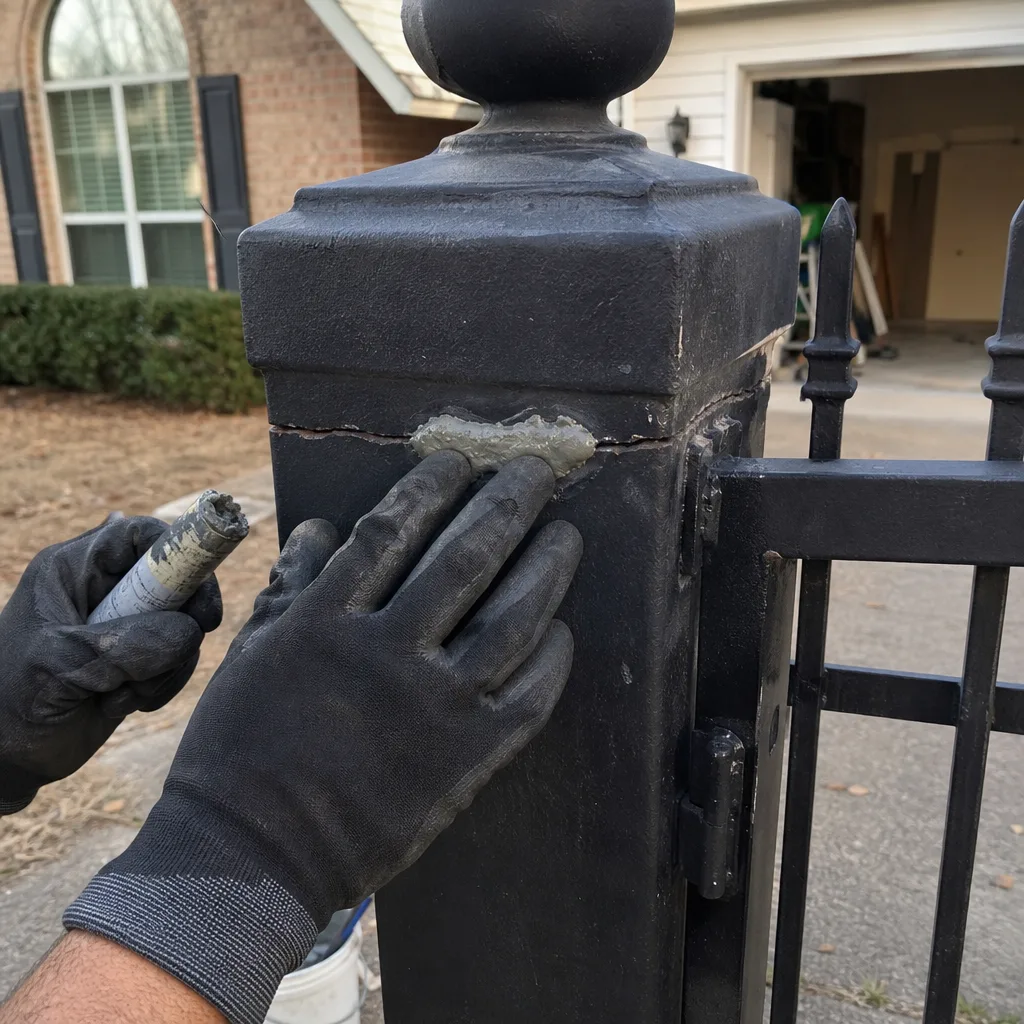
Here’s the single most underused tool in gate repair: your smartphone camera. A technician who arrives with a clear picture of what’s wrong can often diagnose before pulling a tool off the truck. A technician who arrives with “the gate’s been acting weird” starts from zero and burns billable hours just investigating. Here’s how to hand your technician a head start.
Photograph the specific symptom. If a hinge gap looks wide, photograph it with a reference object in frame: a pencil held against the gap, or a coin placed beside the wear point. If a wheel looks worn, photograph the wheel in the track. If a seal is cracked, photograph the crack. Don’t just photograph the whole gate from across the yard. Close-in, specific, well-lit photos are diagnostic evidence.
Photograph the motor and its data plate. Every gate motor carries a data plate with the brand, model, and serial number. A clear photo of that plate lets a technician confirm parts availability and bring the right components on the first trip. It also eliminates guesswork on wiring when the wiring is factory-standard. If you have a Linear, BFT, Viking, or Ghost Controls unit, the data plate photo is the single most useful image you can provide.
Write down the sound and the timing. “It grinds” is less useful than “it grinds for the first three seconds of opening, then goes quiet, and it only happens when the gate has been closed overnight.” When does the sound occur? At the start of travel, the end, or throughout? Does it happen every cycle or intermittently? Does it correlate with rain, cold, or time of day? These specifics map to specific components. The more precisely you describe the timing, the faster the diagnosis.
Count the hesitation. If the gate pauses before moving, time it with your phone. “It pauses about two seconds after I press the remote, then moves normally.” That number, two seconds versus half a second versus five seconds, tells a technician different things about capacitor health versus mechanical resistance versus control-board condition.
Note the history. When did you first notice the symptom? Has it gotten worse? Has anyone already worked on the gate? Previous repairs matter. A gate that had a limit switch replaced last year and is now reversing again points to a different root cause than a gate displaying the same symptom for the first time. Write down what was done and when. Your technician should leave you with a written record of what they found, what they set, and what they installed, plus links to more guides & resources for ongoing maintenance. That record is what allows the next visit to start from knowledge instead of guesswork. Under The Haven Standard, every Vance Gate Repair visit includes a documented photo record of what was found, what was adjusted, and what was replaced, filed with the job record and left with the homeowner. The point of documentation isn’t paperwork. It’s never paying to rediscover the same problem twice.
Immediate Stop vs. Scheduled Repair: Knowing the Difference
Not every warning sign requires the same urgency. Some problems are annoying but allow a normal scheduling window. Others are dangerous to ignore because the failure mode is catastrophic and may involve injury or property damage. Here’s the sorting process we use when homeowners in Humble describe what they’re seeing.
Stop using the gate immediately:
- Any spark, smoke, or burning smell from the operator housing. This is electrical failure in progress. Kill the power to the gate at the breaker and leave it off. Do not cycle the gate again until a technician has inspected it. Burning electrical components in an enclosed housing are a fire hazard.
- A gate that reverses hard into its fully closed position and bounces. This indicates a limit switch failure that’s allowing the gate to over-travel. The gate can bend itself, snap a hinge, or damage the motor mounts. Stop using it.
- A slide gate that’s partially off its track. If the gate is no longer seated properly on the track or the wheels, do not open or close it. A partially derailed gate can tip, and a falling gate panel is heavy enough to cause serious injury or death. This is the point where a professional is the only safe option.
- A cable that’s visibly frayed, broken strands poking out, or a spring that’s stretched or deformed. Gate springs and cables are under high tension. When they let go, they release that energy violently. Do not touch them. Do not try to adjust them. This is a stop-and-call situation, and a technician with the right tools and training should handle it. The risk of serious injury from a failing spring or cable is not worth any DIY attempt.
- A gate that won’t stop when the photo-eye is blocked. If you can interrupt the closing path with a box or a person and the gate keeps closing, the safety circuit has failed. This is the exact failure that photo-eyes exist to prevent. Stop using the gate until the safety system is restored.
Can be scheduled for a repair window:
- A grinding sound during travel. The component is wearing, but the gate typically remains functional for weeks. Document the sound and schedule the repair.
- A pause before movement. Same category. It’s a warning, not an emergency, but every day of hesitation is a day of cumulative motor damage.
- Remote range dropping off. Annoying, rarely dangerous. Schedule it.
- Visible wear on wheels, seals, or hinges. These degrade slowly. Schedule the repair before the degradation becomes breakage.
- A gate that’s slower than it used to be. A scheduled repair is fine, but don’t push it months out. Slower travel is the motor working against resistance, and the resistance is adding wear every cycle.
Why Humble’s Climate and Soil Affect Gate Wear Differently
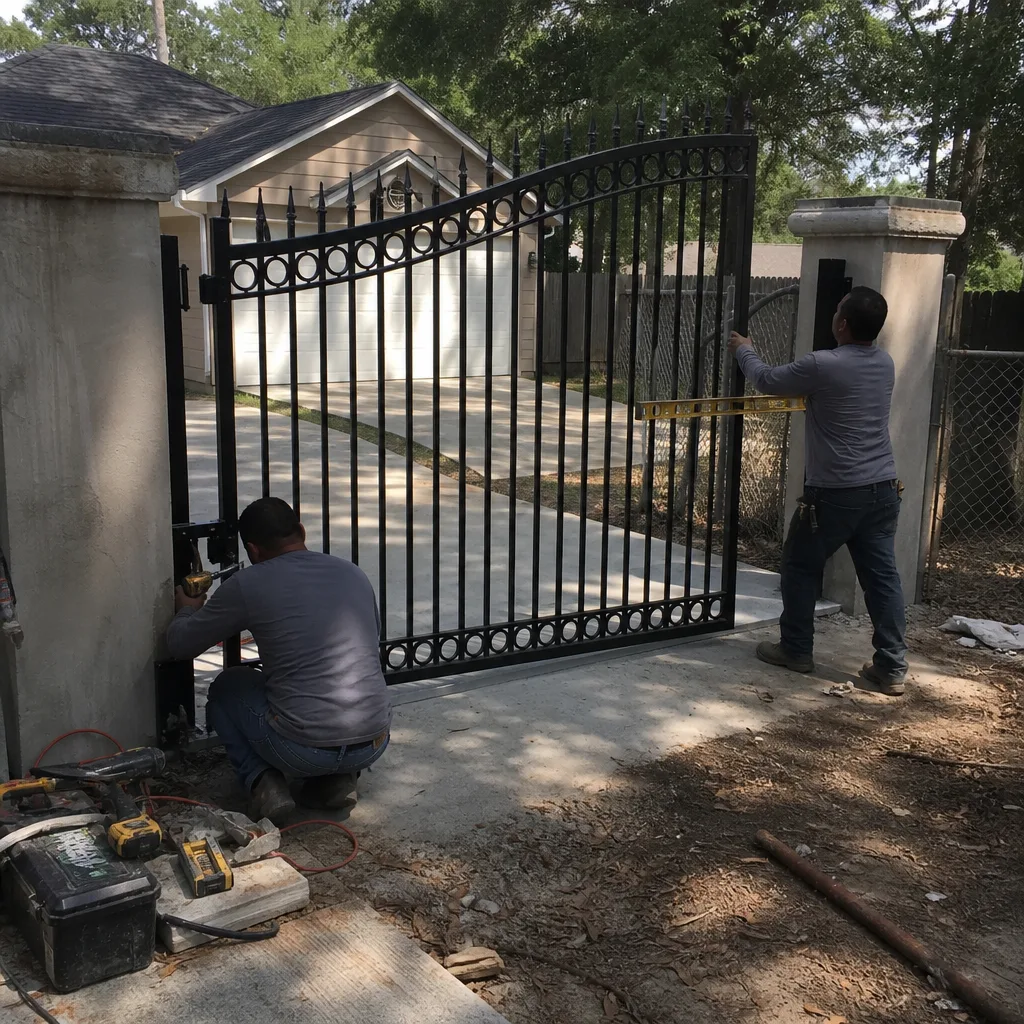
Humble sits on Gulf Coast clay, and that clay does specific things to gate hardware. Clay expands when wet and contracts when dry. Over the course of a year, the soil under your gate posts moves measurably. That movement transfers directly into gate geometry. Hinge gaps change. Latch alignment drifts. Track levels shift. A gate that ran perfectly when installed can find itself binding two years later not because anything failed, but because the ground moved under it. This is one reason we emphasize post plumb checks in this guide. In Humble, posts move even when nothing breaks.
The humidity matters too. Humble averages 80% relative humidity through much of the year, and gate electronics don’t love it. Condensation forms inside operator housings, especially on systems that sit idle during vacations or that see limited morning sun. Circuit boards corrode. Antenna connections oxidize and generate the remote range drop-off we described earlier. The weather seals that look trivial are doing real work here. A failed seal in a Houston-area gate operator means a circuit board failure within a year. The same failed seal in a drier climate might go unnoticed for three years. Your location changes the risk profile.
And the rain matters for drainage. Heavy downpours pool water around posts and inside track channels. A track that holds standing water after a storm is a future bearing failure. A post that sits in saturated clay for weeks is a future lean. If you notice drainage issues around your gate, they’re part of the gate’s long-term health, not a separate landscaping concern. We’ve replaced gate posts in Humble neighborhoods where the root cause was a downspout pointing at the post for five years. The gate didn’t fail. The water table did its work.
What Each Warning Sign Costs to Fix, Caught Early vs. Caught Late
There’s a reason this guide exists. The entire thesis is that early intervention costs a fraction of late intervention. Here’s the math, spelled out per warning sign. These are the price ranges we apply to residential gate work in Humble. They assume a standard residential gate, standard motor brand, and no structural or custom fabrication work.
- Grinding slide-gate wheel bearing: $150 to $400 to replace the wheel assembly early. $600 to $1,200 if the wheel fails completely and the gate derails, bending the wheel bracket and stressing the track.
- Failing start capacitor (the click-click): $120 to $200 for a capacitor replacement. $900 to $1,700 for a motor replacement if the start-winding burns out from repeated failed starts.
- Drifted limit switch (reversal without contact): $150 to $300 for adjustment or replacement of the switch. $500 to $800 if the repeated over-travel bends the gate or damages the gearbox.
- Worn swing-gate hinge: $150 to $400 to replace the hinge set. $800 to $2,000 if the sagging gate drags on the driveway and the motor burns out trying to move it.
- Misaligned photo-eye: $100 to $200 for alignment or replacement. A gate that can’t close reliably is mostly an inconvenience, but a photo-eye that’s been bypassed or falsely aligned is a safety hazard with no easy dollar figure attached.
- Corroded receiver antenna (range drop-off): $100 to $250 for cleaning, reconnection, or antenna replacement. $400 to $800 if the corrosion has spread into the control board and the board needs replacement.
- Bent slide-gate track: $200 to $500 to repair or replace a section of track. $1,200 to $2,500 if the bent track derails the gate and the gate frame itself gets bent. That’s a new panel scenario.
The pattern is consistent: the early repair is a service call. The late repair is a component replacement. The difference is usually not whether you’ll pay, but whether you’ll pay $200 or $1,500. And there’s a second cost nobody budgets for: the downtime. A gate that fails completely means a gate that won’t open when you’re leaving for work, won’t close when you’re leaving for a trip, and leaves your driveway exposed or your car trapped. The scheduled repair happens at your convenience. The emergency repair happens whenever the gate decides, and sometimes that’s Sunday night.
Common Mistakes to Avoid
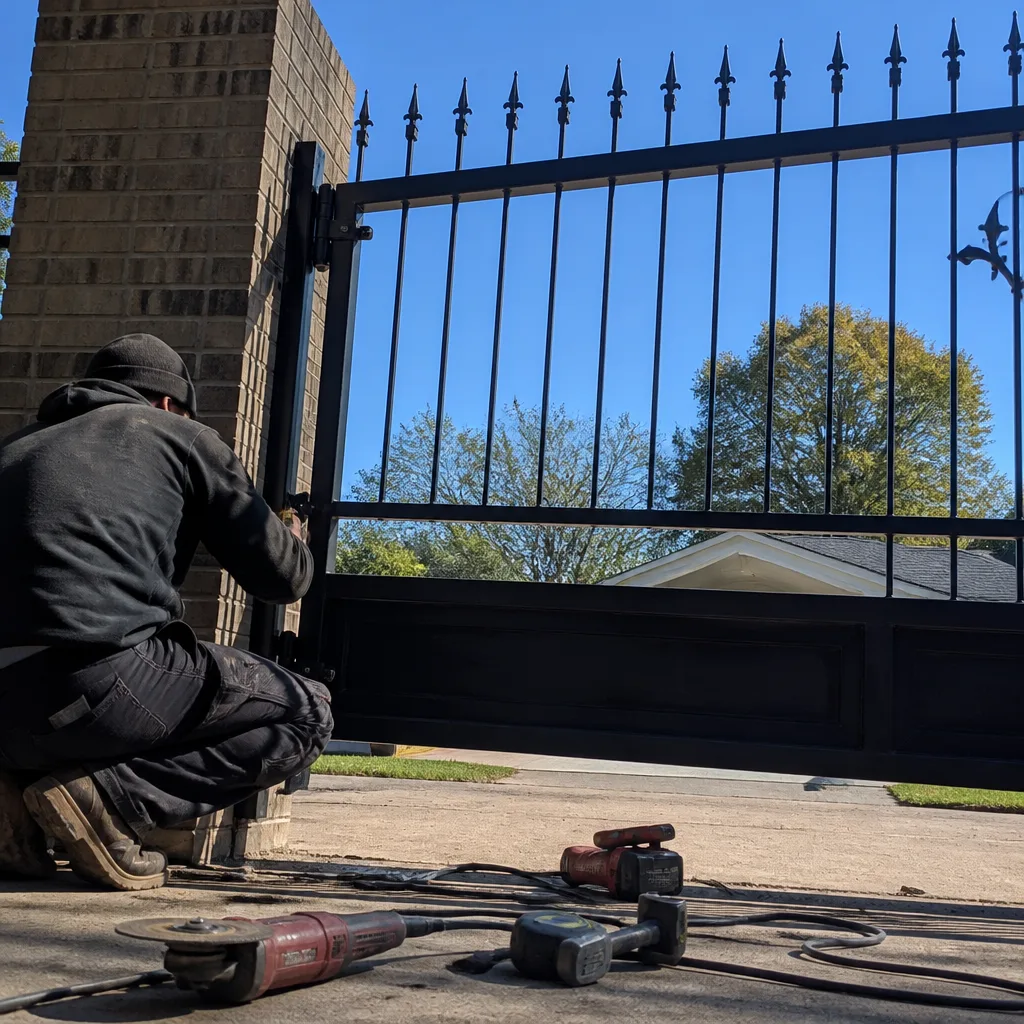
- Replacing the remote batteries every time the range drops. If new batteries don’t fix the range, the problem is almost never the remote. It’s the receiver, the antenna, or interference. Replacing batteries on a working remote just wastes batteries and delays the actual repair.
- Pressing the remote repeatedly when the gate hesitates. Each failed start attempt sends current through the start-winding. Multiple rapid presses in succession dump heat into the motor and accelerate the burnout. One press. If it doesn’t start, stop and document the symptom instead.
- Lubricating the track to fix a grinding sound. Grinding is bearing failure or gear wear. Track lubricant on a gate that’s already grinding does nothing for the bearing and creates a mess that attracts more debris. The correct fix is replacing the worn part.
- Adjusting the limit switches yourself. Limit switches control the gate’s travel extremes. An incorrect adjustment can send the gate past its stops and bend the panel, snap a hinge, or damage the gearbox. This is a $150 professional adjustment, not a DIY experiment. And any adjustments you make will likely need to be undone by the next technician to establish a correct baseline.
- Ignoring a gate that’s “a little slower than it used to be.” Slower travel is increased resistance. Increased resistance is increased current draw. Increased current draw is heat. Heat is cumulative motor damage. Every slow cycle takes days off the motor’s remaining life. This is the warning sign that compounds quietly.
- Skipping the photo-eye test because “it’s always worked before.” Photo-eyes fail gradually. The beam weakens, the alignment drifts, and one day the gate closes on something. Test it monthly. It takes ten seconds and it’s the difference between a working safety system and a lawsuit.
- Believing a verbal estimate protects you. A verbal estimate is a guess with no paper trail. When the job is done and the bill is $400 higher than the number the technician mentioned in passing, you have no record of what was promised. A written estimate protects both sides by fixing the scope and the price before any work starts. Every job at Vance Gate Repair, from a $150 limit switch adjustment to a full gate installation in Humble, starts with a written price handed to the homeowner before the first tool comes off the truck. You should expect that from any gate company you call.
When to Call a Professional
If the gate is off its track, sparking, smoking, reversing hard, or the safety photo-eye has failed, call a professional today and stop using the gate until they arrive. If the gate is grinding, hesitating, slowing, or dropping remote range, you have a schedule window, but the window is measured in weeks, not months. If you’ve done the visual checks and something looks off but you can’t identify the component, call for a diagnosis or read How to Hire a Gate Repair Contractor in Humble: A Step-by-Step Guide. Vance Gate Repair Humble offers free estimates for homeowners in Humble. We’ll bring a written price before any work starts, and we’ll leave a documented record of what we found, whether you hire us for the repair or not. Call (346) 423-6136.
If you’re not in Humble proper but near the area, we’re still likely your closest option. Our gate repair service covers Humble and the surrounding communities. And if you’re dealing with an older motor that’s finally given up, we can walk you through gate motor and opener replacement in Humble with the same written-price, documented-record standard. For a full overview of what we do, start at the Vance Gate Repair Humble home page.
Frequently Asked Questions
The first signs are usually behavioral before they’re catastrophic: a pause between the remote press and the gate moving, a gate that’s slower than it used to be, a change in motor pitch, or the gate refusing to start on the first try. All of these indicate the motor is working harder than it should, and the cause should be found before the motor burns out. Call (346) 423-6136 for a diagnosis and a written estimate, free of charge.
The pause is usually the start-winding struggling to generate torque, which points to a failing start capacitor, a mechanical bind, or a motor nearing the end of its life. Timing the pause with your phone and noting when it happens (cold mornings, first cycle of the day, every time) gives a technician the data they need to pre-diagnose. The longer the hesitation continues, the higher the risk of full motor failure, which triples the repair cost.
Most gate repairs in Humble fall between $150 and $800, depending on the component. A limit switch adjustment runs $150 to $300. A wheel assembly replacement runs $150 to $400. A motor replacement runs $900 to $1,700. A full replacement gate can run $2,000 to $12,000 depending on size, material, and automation. The range is wide because the variables are real, which is why a written estimate based on your specific gate, your motor brand, and the actual failure is the only number you should trust. Call (346) 423-6136 for a free written estimate.
For breakdowns and emergency situations, we prioritize same-day response wherever possible. A live person answers the phone 24 hours a day at (346) 423-6136, and we’ll tell you honestly what the schedule looks like. If the gate is off its track or the safety system has failed, we’ll do everything we can to get a technician to you the same day.
Yes. We service nine major gate-automation brands including Viking, BFT, Linear, and Ghost Controls, plus LiftMaster, FAAC, DoorKing, Elite, and Mighty Mule. We repair whatever motor is already on your property. We don’t steer homeowners toward a replacement when a repair is the right and more affordable fix.
Photograph the motor’s data plate (brand, model, serial number), the specific symptom if it’s visible (worn wheel, sagging hinge, cracked seal), and a full shot of the gate from the driveway. The data plate photo is the single most useful image you can provide because it confirms parts availability and electrical configuration. Send these photos when you call, and your technician will arrive with context instead of starting from zero. Call (346) 423-6136 and we’ll tell you exactly what to photograph.
The Bottom Line
Gate failures don’t come out of nowhere. They come out of grinding sounds that were tolerated, hesitations that were dismissed, and range drops that were blamed on batteries. Every one of those warning signs is a message from a specific component about its remaining lifespan, and every one of them is cheaper to address today than to ignore for three more months. The tools you need are a phone camera, a pencil for measuring hinge gaps, and the willingness to document what the gate is telling you. Do that, and when you call for gate repair in Humble, your technician will arrive with a diagnosis already half-formed. That’s the difference between a service call and a surprise invoice, and it starts with noticing the pause.
Written by Adrian Vance, Owner at Vance Gate Repair Humble, serving Humble since 2014.